JOANNES PAVLVS II PONT. MAX Visit to Karachi February 18, 1981
JOANNES PAVLVS II PONT. MAX Visit to Karachi February 18, 1981


JOANNES PAVLVS II PONT. MAX Visit to Karachi February 18, 1981
Availability: Yes
Contact Us @ : syedshamailahmed@gmail.com
Philately (/fɪˈlætəliː/; fi-LAT-ə-lee) is the study of postage stamps and postal history. It also refers to the collection, appreciation and research activities on stamps and other philatelic products. Philately involves more than just stamp collecting or the study of postage; it is possible to be a philatelist without owning any stamps.[1] For instance, the stamps being studied may be very rare or reside only in museums.
Etymology[edit]
The word "philately" is the English transliteration of the French "philatélie", coined by Georges Herpin in 1864.[2] Herpin stated that stamps had been collected and studied for the previous six or seven years and a better name was required for the new hobby than timbromanie (roughly "stamp quest"), which was disliked.[3] The alternative terms "timbromania", "timbrophily" and "timbrology" gradually fell out of use as philately gained acceptance during the 1860s.[3] He took the Greek root word φιλ(ο)- phil(o)-, meaning "an attraction or affinity for something", and ἀτέλεια ateleia, meaning "exempt from duties and taxes" to form "philatelie".[4]
History[edit]
Nineteenth century[edit]
As a collection field, philately appeared after the introduction of the postage stamps in 1840,[5][6] but did not gain large attraction until the mid-1850s. Some authors[6] believe that the first philatelist appeared on the day of the release of the world's first postage stamp, dated to 6 May 1840, when the Liverson, Denby and Lavie London law office sent a letter to Scotland franked with ten uncut Penny Blacks, stamped with the postmark "LS.6MY6. 1840." In 1992 at an auction in Zurich, this envelope was sold for 690 thousand francs.[7]
Already in 1846, cases of collecting stamps in large numbers were known in England. However, without reason for collection, stamps at this time were used for pasting wallpaper. The first philatelist is considered to be a postmaster going by Mansen, who lived in Paris, and in 1855 had sold his collection, which contained almost all the postage stamps issued by that time. The stamp merchant and second-hand book dealer Edard de Laplante bought it, recognizing the definitive collector's worth of the postage stamp.[8] Due to the boom in popularity and news of this transaction, stamp merchants like Laplante began to emerge.
Towards the end of the 19th century stamp collecting reached hundreds of thousands of people of all classes. Even some states had collections of postage stamps, for example, England, Germany, France, Bavaria, and Bulgaria). In countries who held national collections, museums were built to dedicate that nation's history with philately, and the first such appeared in Germany, France, and Bulgaria. Allegedly, the first of these museums housed the collection of the British Museum, curated by MP Tapling and bequeathed to the Museum in 1891. The Museum für Kommunikation Berlin also had an extensive collection of stamps. The largest collection of the time belonged to Baron Philipp von Ferrary in Paris.[6]
As the number of postage stamp issues increased every year, collection became progressively difficult. Therefore, from the early 1880s, "collector experts" appeared, specializing their collection to only one part of the world, a group of nations, or even only one.[9]
Twentieth century[edit]
Philately as one of the most popular types of collecting continued to develop in the 20th century. Along with the "Scott", "Stanley Gibbons", and "Yvert et Tellier" catalogs, the "Zumstein" (first published in Switzerland, 1909), and the "Michel" (first published in Germany, 1910) catalogs began publication.
In 1934, the idea to celebrate an annual Postage Stamp Day was suggested by Hans von Rudolphi, a German philatelist.[10] The idea was adopted rapidly in Germany, and gained later adoption in other countries. Stamp Day is a memorial day established by the postal administration of a country and annually celebrated, which is designed to attract public attention to, popularize the use of, and expand the reach of postal correspondence, and contribute to the development of philately.[6] In 1968, Cuba dedicated a postage stamp for Stamp Day with an image of G. Sciltian's "El filatelista".[11]
In 1926, the Fédération Internationale de Philatélie (FIP) was founded, where international philatelic exhibitions have been regularly organized since 1929.[6] The first World Philatelic Exhibition in Prague was held between August and September 1962;[12] in 1976, the FIP brought together national societies from 57 countries, which held over 100 exhibitions, and in 1987, over 60 countries entered the FIP.[6]
Since the middle of the 20th century, philately has become the most widespread field of amateur collecting, which was facilitated by:[9]
- significantly expanded postal exchanges between countries,
- many countries' post offices issuing:
- commemorative emissions,
- multicolor series of stamps devoted to history, the most important events of our time, art, fauna, flora, sports, etc. .;
- individual stamps, sheets (a sheet with one or more printed stamps and inscription on the margins) and items intended specifically for philatelists;
- widespread sale of collection signs of postage (including commissioned ones), albums, stockbooks and other items of philately;
- publication of stamp catalogs;
- national and international exhibitions organized by philatelic societies, domestic and international exchanges, philately propaganda through specialized magazines and other periodicals.[13]
Philately magazines, at this time, were published as far east as Poland, and as far west as North America. In Canada, Canadian Stamp News was established in 1976 as an off-shoot to Canadian Coin News, which was launched about a decade earlier.
Philately was largely advanced by the USSR and nations within its sphere of influence, and the United States, France, the UK, and Austria. The British Library Philatelic Collections and the postal museums in Stockholm, Paris, and Bern had unique national philately collections at that time, and among the famous private collections are those of the Royal Philatelic Collection, F. Ferrari (Austria),[6] M. Burrus (Switzerland), A. Lichtenstein, A. Hind, J. Boker (USA), and H. Kanai (Japan).
In the mid-1970s, national philately organizations and associations existed in most countries, and 150-200 million people were involved in philately during meetings established.[14][5]
Twenty-first century[edit]
From 28 August to 1 September 2004, the World Stamp Championship was held for the first time in the history of world philately in Singapore.[15]
Types[edit]
Traditional philately is the study of the technical aspects of stamp production and stamp identification, including:[9]
- The stamp design process
- The paper used (wove, laid and including watermarks)
- The method of printing (engraving, typography)
- The gum
- The method of separation (perforation, rouletting)
- Any overprints on the stamp
- Any security markings, underprints or perforated initials ("perfins")
- The study of philatelic fakes and forgeries
Diversification[16][edit]
- Thematic philately, also known as topical philately, is the study of what is depicted on individual stamps. There are hundreds of popular subjects, such as birds, and ships, poets, presidents, monarchs, maps, aircraft, spacecraft, sports, and insects on stamps. Stamps depicted on stamps also constitute a topical area of collecting. Interesting aspects of topical philately include design mistakes and alterations; for instance, the recent editing out of cigarettes from the pictures used for United States stamps, and the stories of how particular images came to be used.
- Postal history studies the postal systems and how they operate and, or, the study of postage stamps and covers and associated material illustrating historical episodes of postal systems both before and after the introduction of the adhesive stamps. It includes the study of postmarks, post offices, postal authorities, postal rates and regulations and the process by which letters are moved from sender to recipient, including routes and choice of conveyance. A classic example is the Pony Express, which was the fastest way to send letters across the United States during the few months that it operated. Covers that can be proven to have been sent by the Pony Express are highly prized by collectors.
- Aerophilately is the branch of postal history that specializes in the study of airmail. Philatelists have observed the development of mail transport by air from its beginning, and all aspects of airmail services have been extensively studied and documented by specialists.
- Astrophilately is the branch of postal history that specializes in the study of stamps and postmarked envelopes that are connected to outer space.
- Postal stationery includes stamped envelopes, postal cards, letter sheets, aérogrammes (airletter sheets) and wrappers, most of which have an embossed or imprinted stamp or indicia indicating the prepayment of postage.
- Erinnophilia is the study of objects that look like stamps, but are not postal stamps. Examples include Easter Seals, Christmas Seals, propaganda labels, and so forth.
- Philatelic literature documents the results of the philatelic study and includes thousands of books and periodicals.
- Revenue philately is the study of stamps used to collect taxes or fees on such things as legal documents, court fees, receipts, tobacco, alcoholic drinks, drugs and medicines, playing cards, hunting licenses and newspapers.
- Maximaphily is the study of Maximum Cards. Maximum Cards can be defined as a picture postcard with a postage stamp on the same theme and cancellation, with a maximum concordance between all three.
Tools[edit]
Philately uses several tools, including stamp tongs (a specialized form of tweezers) to safely handle the stamps, a strong magnifying glass and a perforation gauge (odontometer) to measure the perforation gauge of the stamp.
The identification of watermarks is equally important and may be done with the naked eye by turning the stamp over or holding it up to the light. If this fails then watermark fluid may be used, which "wets" the stamp to reveal the mark.
Other common tools include stamp catalogs, stamp stock books and stamp hinges.
including coins, tokens, paper money and related objects. While numismatists are often characterised as students or collectors of coins, the discipline also includes the broader study of money and other payment media used to resolve debts and the exchange of goods. Early money used by people is referred to as "Odd and Curious", but the use of other goods in barter exchange is excluded, even where used as a circulating currency (e.g., cigarettes in prison). As an example, the Kyrgyz people used horses as the principal currency unit and gave small change in lambskins;[1] the lambskins may be suitable for numismatic study, but the horses are not. Many objects have been used for centuries, such as cowry shells, precious metals, cocoa beans, large stones, and gems.
Etymology[edit]
First attested in English 1829, the word numismatics comes from the adjective numismatic, meaning "of coins". It was borrowed in 1792 from French numismatiques, itself a derivation from Late Latin numismatis, genitive of numisma, a variant of nomisma meaning "coin".[2] Nomisma is a latinisation of the Greek νόμισμα (nomisma) which means "current coin/custom",[3] which derives from νομίζω (nomizō), "to hold or own as a custom or usage, to use customarily",[4] in turn from νόμος (nomos), "usage, custom",[5] ultimately from νέμω (nemō), "I dispense, divide, assign, keep, hold".[6]
History of money[edit]
Throughout its history, money itself has been made to be a scarce good, although it does not have to be. Many materials have been used to form money, from naturally scarce precious metals and cowry shells through cigarettes to entirely artificial money, called fiat money, such as banknotes. Many complementary currencies use time as a unit of measure, using mutual credit accounting that keeps the balance of money intact.
Modern money (and most ancient money too) is essentially a token – an abstraction. Paper currency is perhaps the most common type of physical money today. However, goods such as gold or silver retain many of the essential properties of money, such as volatility and limited supply. However, these goods are not controlled by one single authority.
History of numismatics[edit]
Petrarch, who wrote in a letter that he was often approached by vinediggers with old coins asking him to buy or to identify the ruler, is credited as the first Renaissance collector. Petrarch presented a collection of Roman coins to Emperor Charles IV in 1355.Coin collecting may have possibly existed in ancient times. Caesar Augustus gave "coins of every device, including old pieces of the kings and foreign money" as Saturnalia gifts.[7]
The first book on coins was De Asse et Partibus (1514) by Guillaume Budé.[8] During the early Renaissance ancient coins were collected by European royalty and nobility. Collectors of coins were Pope Boniface VIII, Emperor Maximilian of the Holy Roman Empire, Louis XIV of France, Ferdinand I, Elector Joachim II of Brandenburg who started the Berlin coin cabinet and Henry IV of France to name a few. Numismatics is called the "Hobby of Kings", due to its most esteemed founders.
Professional societies organised in the 19th century. The Royal Numismatic Society was founded in 1836 and immediately began publishing the journal that became the Numismatic Chronicle. The American Numismatic Society was founded in 1858 and began publishing the American Journal of Numismatics in 1866.
In 1931 the British Academy launched the Sylloge Nummorum Graecorum publishing collections of Ancient Greek coinage. The first volume of Sylloge of Coins of the British Isles was published in 1958.
In the 20th century coins gained recognition as archaeological objects, scholars such as Guido Bruck of the Kunsthistorisches Museum in Vienna realised their value in providing a temporal context and the difficulty that curators faced when identifying worn coins using classical literature. After World War II in Germany a project, Fundmünzen der Antike (Coin finds of the Classical Period) was launched, to register every coin found within Germany. This idea found successors in many countries.
In the United States, the US mint established a coin cabinet in 1838 when chief coiner Adam Eckfeldt donated his personal collection.[9] William E. Du Bois’ Pledges of History... (1846) describes the cabinet.
C. Wyllys Betts' American colonial history illustrated by contemporary medals (1894) set the groundwork for the study of American historical medals.
Helen Wang's "A short history of Chinese numismatics in European languages" (2012-2013) gives an outline history of Western countries' understanding of Chinese numismatics.[10] Lyce Jankowski's Les amis des monnaies is an in-depth study of Chinese numismatics in China in the 19th century.[11]
Modern numismatics[edit]
Subfields[edit]Modern numismatics is the study of the coins of the mid-17th century onward, the period of machine-struck coins.[12] Their study serves more the need of collectors than historians and it is more often successfully pursued by amateur aficionados than by professional scholars. The focus of modern numismatics lies frequently in the research of production and use of money in historical contexts using mint or other records in order to determine the relative rarity of the coins they study. Varieties, mint-made errors, the results of progressive die wear, mintage figures and even the sociopolitical context of coin mintings are also matters of interest.
Exonumia (UK English: Paranumismatica)[13] is the study of coin-like objects such as token coins and medals, and other items used in place of legal currency or for commemoration. This includes elongated coins, encased coins, souvenir medallions, tags, badges, counterstamped coins, wooden nickels, credit cards, and other similar items. It is related to numismatics proper (concerned with coins which have been legal tender), and many coin collectors are also exonumists.
Notaphily is the study of paper money or banknotes. It is believed that people have been collecting paper money for as long as it has been in use. However, people only started collecting paper money systematically in Germany in the 1920s, particularly the Serienscheine (Series notes) Notgeld. The turning point occurred in the 1970s, when notaphily was established as a separate area by collectors. At the same time, some developed countries such as the United States, Germany and France began publishing their respective national catalogues of paper money, which represented major points of reference literature.
Scripophily is the study and collection of stocks and Bonds. It is an area of collecting due to both the inherent beauty of some historical documents as well as the interesting historical context of each document. Some stock certificates are excellent examples of engraving. Occasionally an old stock document will be found that still has value as a stock in a successor company.
Numismatists[edit]
The term numismatist applies to collectors and coin dealers as well as scholars using coins as source or studying coins.[14]
The first group chiefly derive pleasure from the simple ownership of monetary devices and studying these coins as private amateur scholars. In the classical field amateur collector studies have achieved quite remarkable progress in the field. Examples are Walter Breen, a well-known example of a noted numismatist who was not an avid collector, and King Farouk I of Egypt was an avid collector[15] who had very little interest in numismatics. Harry Bass by comparison was a noted collector who was also a numismatist.
The second group are the coin dealers. Often called professional numismatists, they authenticate or grade coins for commercial purposes. The buying and selling of coin collections by numismatists who are professional dealers advances the study of money, and expert numismatists are consulted by historians, museum curators, and archaeologists.
The third category are scholar numismatists working in public collections, universities or as independent scholars acquiring knowledge about monetary devices, their systems, their economy and their historical context.[16] An example would be G. Kenneth Jenkins. Coins are especially relevant as source in the pre-modern period.
List of publicly displayed numismatic collections[edit]
List of important numismatic scholars[edit]
- Andreas Alföldi (1895–1981)
- Augusto Carlos Teixeira de Aragão
- Marion Archibald (1935-2016)
- Simone Assemani (1752–1820)
- Churchill Babington
- Anselmo Banduri
- Georges Bataille
- Osmund Bopearachchi
- Bartolomeo Borghesi
- Guido Bruck
- Guillaume Budé
- Francesco Carelli
- Celestino Cavedoni
- Joan Clarke
- Henry Cohen
- Joe Cribb[21]
- Théophile Marion Dumersan
- Stephan Ladislaus Endlicher
- Giuseppe Fiorelli
- Martin Folkes
- Julius Friedländer
- Andrea Fulvio
- Raffaele Garrucci
- Francesco Gnecchi
- Philip Grierson
- Claude Gros de Boze
- P. L. Gupta
- Nicola Francesco Haym (1678–1729)
- Stefan Heidemann
- David Hendin
- Gene Hessler
- G. Kenneth Jenkins[22]
- Joel L. Malter
- Harold Mattingly
- Theodor Mommsen
- B. N. Mukherjee
- A. K. Narain
- Eric P. Newman
- Carlo Ottavio, Count Castiglione
- Martin Price (numismatist)
- Louis Robert
- Desiré-Raoul Rochette
- Joaquín Rubio y Muñoz
- Eduard Rüppell
- Antonio Salinas
- Gustave Schlumberger
- Charles Seltman
- Camillo Serafini
- Ajay Mitra Shastri
- Adolf Soetbeer
- Dmitry Sontsov
- Frederic Soret
- Johann Gustav Stickel
- Charles Surasky
- Francois Thierry[23]
- Olaus Gerhard Tychsen
- Jörgen Zoega
See also[edit]
- Numismatist (specialist)
- Awards for numismatics
- Numismatic associations
- List of numismatic collections
- List of numismatic journals
- Silk Road Numismatics
- Coin collecting
- Coin grading
- Coin catalog
- Coin roll hunting – searching coin rollsfor coins of numismatic value
- Glossary of numismatics
- Joseph Pellerin
- Commodity money
- Money creation
- Where's George?
- Where's Willy?A postage stamp is a small piece of paper issued by a post office, postal administration, or other authorized vendors to customers who pay postage (the cost involved in moving, insuring, or registering mail), who then affix the stamp to the face or address-side of any item of mail—an envelope or other postal cover (e.g., packet, box, mailing cylinder)—that they wish to send. The item is then processed by the postal system, where a postmark or cancellation mark—in modern usage indicating date and point of origin of mailing—is applied to the stamp and its left and right sides to prevent its reuse. The item is then delivered to its addressee.
Always featuring the name of the issuing nation (with the exception of the United Kingdom), a denomination of its value, and often an illustration of persons, events, institutions, or natural realities that symbolize the nation's traditions and values, every stamp is printed on a piece of usually rectangular, but sometimes triangular or otherwise shaped special custom-made paper whose back is either glazed with an adhesive gum or self-adhesive.
Because governments issue stamps of different denominations in unequal numbers and routinely discontinue some lines and introduce others, and because of their illustrations and association with the social and political realities of the time of their issue, they are often prized for their beauty and historical significance by stamp collectors whose study of their history and of mailing systems is called philately. Because collectors often buy stamps from an issuing agency with no intention to use them for postage, the revenues from such purchases and payments of postage can make them a source of net profit to that agency. On 1 May 1840, the Penny Black, the first adhesive postage stamp, was issued in the United Kingdom. Within three years postage stamps were introduced in Switzerland and Brazil, a little later in the United States, and by 1860, they were in 90 countries around the world.[1] The first postage stamps did not need to show the issuing country, so no country name was included on them. Thus the United Kingdom remains the only country in the world to omit its name on postage stamps; the monarch's image signifies the United Kingdom as the country of origin.[2]
Invention[edit]
Throughout modern history, numerous methods were used to indicate that postage had been paid on a mailed item, so several different men have received credit for inventing the postage stamp.
William Dockwra[edit]
In 1680, William Dockwra, an English merchant in London, and his partner Robert Murray established the London Penny Post, a mail system that delivered letters and small parcels inside the city of London for the sum of one penny. Confirmation of paid postage was indicated by the use of a hand stamp to frank the mailed item. Though this "stamp" was applied to the letter or parcel itself, rather than to a separate piece of paper, it is considered by many historians to be the world's first postage stamp.[3]
Lovrenc Košir[edit]
In 1835, the civil servant Lovrenc Košir from Ljubljana in Austria-Hungary (now Slovenia), suggested the use of "artificially affixed postal tax stamps"[4] using "gepresste Papieroblate" ("pressed paper wafers"), but although civil bureaucrats considered the suggestion in detail, it was not adopted.[5][6] The 'Papieroblate' were to produce stamps as paper decals so thin as to prevent their reuse.[7]
Rowland Hill[edit]
In 1836, Robert Wallace, a Member of (British) Parliament, gave Sir Rowland Hill numerous books and documents about the postal service, which Hill described as a "half hundred weight of material".[8][9] After a detailed study, on 4 January 1837 Hill submitted a pamphlet entitled Post Office Reform: Its Importance and Practicability, marked "private and confidential", and not released to the general public, to the Chancellor of the Exchequer, Thomas Spring Rice.[10] The Chancellor summoned Hill to a meeting at which he suggested improvements and changes to be presented in a supplement, which Hill duly produced and submitted on 28 January 1837.[11]
Summoned to give evidence before the Commission for Post Office Enquiry on 13 February 1837, Hill read from the letter he wrote to the Chancellor that included a statement saying that the notation of paid postage could be created... by using a bit of paper just large enough to bear the stamp, and covered at the back with a glutinous wash..."[12][13] This would eventually become the first unambiguous description of a modern adhesive postage stamp (though the term "postage stamp" originated at later date). Shortly afterward, Hill's revision of the booklet, dated 22 February 1837, containing some 28,000 words, incorporating the supplement given to the Chancellor and statements he made to the commission, was published and made available to the general public. Hansard records that on 15 December 1837, Benjamin Hawes asked the Chancellor of the Exchequer "whether it was the intention of the Government to give effect to the recommendation of the Commissioners of the Post-office, contained in their ninth report relating to the reduction of the rates of postage, and the issuing of penny stamps?"[14]
Hill's ideas for postage stamps and charging paid-postage based on weight soon took hold, and were adopted in many countries throughout the world.[1] With the new policy of charging by weight, using envelopes for mailing documents became the norm. Hill's brother Edwin invented a prototype envelope-making machine that folded paper into envelopes quickly enough to match the pace of the growing demand for postage stamps.[15]
Rowland Hill and the reforms he introduced to the United Kingdom postal system appear on several of its commemorative stamps.[15]
James Chalmers[edit]
In the 1881 book The Penny Postage Scheme of 1837, Scotsman Patrick Chalmers claimed that his father, James Chalmers, published an essay in August 1834 describing and advocating a postage stamp, but submitted no evidence of the essay's existence. Nevertheless, until he died in 1891, Patrick Chalmers campaigned to have his father recognized as the inventor of the postage stamp.[16]
The first independent evidence for Chalmers' claim is an essay, dated 8 February 1838 and received by the Post Office on 17 February 1838, in which he proposed adhesive postage stamps to the General Post Office.[17] In this approximately 800-word document concerning methods of indicating that postage had been paid on mail he states:
- "Therefore, of Mr Hill's plan of a uniform rate of postage... I conceive that the most simple and economical mode... would be by Slips... in the hope that Mr Hill's plan may soon be carried into operation I would suggest that sheets of Stamped Slips should be prepared... then be rubbed over on the back with a strong solution of gum...".
Chalmers' original document is now in the United Kingdom's National Postal Museum.
Since Chalmers used the same postage denominations that Hill had proposed in February 1837, it is clear that he was aware of Hill's proposals, but whether he obtained a copy of Hill's booklet or simply read about it in one or both of the two detailed accounts (25 March 1837[18] and 20 December 1837[19]) published in The Times is unknown. Neither article mentioned "a bit of paper just large enough to bear the stamp", so Chalmers could not have known that Hill had made such a proposal. This suggests that either Chalmers had previously read Hill's booklet and was merely elaborating Hill's idea, or he had independently developed the idea of the modern postage stamp.
James Chalmers organized petitions "for a low and uniform rate of postage". The first such petition was presented in the House of Commons on 4 December 1837 (from Montrose).[20] Further petitions organised by him were presented on 1 May 1838 (from Dunbar and Cupar), 14 May 1838 (from the county of Forfar), and 12 June 1839. At this same time, other groups organised petitions and presented them to Parliament. All petitions for consumer-oriented, low-cost, volume-based postal rates followed publication of Hill's proposals.
Other claimants[edit]
Other claimants include or have included[21]
- Dr John Gray of the British Museum
- Samuel Forrester, a Scottish tax official
- Charles Whiting, a London stationer
- Samuel Roberts of Llanbrynmair, Wales
- Francis Worrell Stevens, schoolmaster at Loughton
- Ferdinand Egarter of Spittal, Austria
- Curry Gabriel Treffenberg from Sweden
History[edit]
The nineteenth century[edit]
Postage stamps have facilitated the delivery of mail since the 1840s. Before then, ink and hand-stamps (hence the word 'stamp'), usually made from wood or cork, were often used to frank the mail and confirm the payment of postage. The first adhesive postage stamp, commonly referred to as the Penny Black, was issued in the United Kingdom in 1840. The invention of the stamp was part of an attempt to improve the postal system in the United Kingdom of Great Britain and Ireland,[22] which, in the early 19th century, was in disarray and rife with corruption.[23] There are varying accounts of the inventor or inventors of the stamp.[24]
Before the introduction of postage stamps, mail in the United Kingdom was paid for by the recipient, a system that was associated with an irresolvable problem: the costs of delivering mail were not recoverable by the postal service when recipients were unable or unwilling to pay for delivered items, and senders had no incentive to restrict the number, size, or weight of items sent, whether or not they would ultimately be paid for.[25] The postage stamp resolved this issue in a simple and elegant manner, with the additional benefit of room for an element of beauty to be introduced. Concurrently with the first stamps, the United Kingdom offered wrappers for mail. Later related inventions include postal stationery such as prepaid-postage envelopes, post cards, lettercards, aerogrammes, postage meters, and, more recently, specialty boxes and envelopes provided free to the customer by the United States Postal Service for priority or express mailing.
The postage stamp afforded convenience for both the mailer and postal officials, more effectively recovered costs for the postal service, and ultimately resulted in a better, faster postal system. With the conveniences stamps offered, their use resulted in greatly increased mailings during the 19th and 20th centuries.[26] Postage stamps during this era were the most popular way of paying for mail; however, by the end of the 20th century were rapidly being eclipsed by the use of metered postage and bulk mailing by businesses.[27][28]
As postage stamps with their engraved imagery began to appear on a widespread basis, historians and collectors began to take notice.[29] The study of postage stamps and their use is referred to as philately. Stamp collecting can be both a hobby and a form of historical study and reference, as government-issued postage stamps and their mailing systems have always been involved with the history of nations.[30][31]
Although a number of people laid claim to the concept of the postage stamp, it is well documented that stamps were first introduced in the United Kingdom of Great Britain and Ireland on 1 May 1840 as a part of postal reforms promoted by Sir Rowland Hill.[1] With its introduction, the postage fee was paid by the sender and not the recipient, though it was still possible to send mail without prepaying. From when the first postage stamps were used, postmarks were applied to prevent the stamps being used again.[32][33]
The first stamp, the "Penny black", became available for purchase 1 May 1840, to be valid as of 6 May 1840. Two days later, 8 May 1840, the Two penny blue was introduced. The Penny black was sufficient for a letter less than half an ounce to be sent anywhere within the United Kingdom. Both stamps included an engraving of the young Queen Victoria, without perforations, as the first stamps were separated from their sheets by cutting them with scissors.
The first stamps did not need to show the issuing country, so no country name was included on them. The United Kingdom remains the only country to omit its name on postage stamps,[2][34] using the reigning monarch's head as country identification. Following the introduction of the postage stamp in the United Kingdom, prepaid postage considerably increased the number of letters mailed. Before 1839, the number of letters sent in the United Kingdom was typically 76 million. By 1850, this increased five-fold to 350 million, continuing to grow rapidly[26] until the end of the 20th century when newer methods of indicating the payment of postage reduced the use of stamps.
Other countries soon followed the United Kingdom with their own stamps.[1] The Canton of Zürich in Switzerland issued the Zurich 4 and 6 rappen on 1 March 1843. Although the Penny black could be used to send a letter less than half an ounce anywhere within the United Kingdom, the Swiss did not initially adopt that system, instead continuing to calculate mail rates based on distance to be delivered. Brazil issued the Bull's Eye stamp on 1 August 1843. Using the same printer used for the Penny black, Brazil opted for an abstract design instead of the portrait of Emperor Pedro II, so his image would not be disfigured by a postmark.
In 1845, some postmasters in the United States issued their own stamps, but it was not until 1847 that the first official United States stamps were issued: 5 and 10 cent issues depicting Benjamin Franklin and George Washington. A few other countries issued stamps in the late 1840s. The famous Mauritius "Post Office" stamps were issued by Mauritius in September 1847. Many others, such as India, started their use in the 1850s, and by the 1860s most countries issued stamps.
Perforation of postage stamps began in January 1854.[35] The first officially perforated stamps were issued in February 1854. Stamps from Henry Archer's perforation trials were issued in the last few months of 1850; during the 1851 parliamentary session[35] at the House of Commons of the United Kingdom; and finally in 1853/54 after the United Kingdom government paid Archer £4,000 for his machine and the patent.[35]
The Universal Postal Union, established in 1874, prescribed that nations shall only issue postage stamps according to the quantity of real use, and no living persons shall be taken as subjects. The latter rule lost its significance after World War I.[36]
The twentieth and twenty-first century[edit]
After World War II, it became customary in some countries, especially small Arab nations, to issue postage stamps en masse as it was realized how profitable that was.[36]
During the 21st century, the amount of mail — and the use of postage stamps, accordingly — has reduced in the world because of electronic mail and other technological innovations. Iceland has already announced that it will not issue new stamps anymore because the sales have decreased and there are enough stamps in the stock.[36]
Design[edit]
When the first postage stamps were issued in the 1840s, they followed an almost identical standard in shape, size and general subject matter. They were rectangular in shape. They bore the images of Queens, Presidents and other political figures. They also depicted the denomination of the postage-paid, and with the exception of the United Kingdom,[note 1] depicted the name of the country from which issued.[note 2] Nearly all early postage stamps depict images of national leaders only.
Soon after the introduction of the postage stamp, other subjects and designs began to appear. Some designs were welcome, others widely criticized. For example, in 1869, the United States Post Office broke tradition of depicting presidents or other famous historical figures, instead using other subjects including a train, and horse.(See: 1869 Pictorial Issue.) The change was greeted with general disapproval, and sometimes harsh criticism from the American public.[38][39]
Perforations[edit]
Perforations are small holes made between individual postage stamps on a sheet of stamps,[40] facilitating separation of a desired number of stamps. The resulting frame-like, rippled edge surrounding the separated stamp defines a characteristic meme for the appearance of a postage stamp.
In the first decade of postage stamps' existence (depending on the country), stamps were issued without perforations. Scissors or other cutting mechanisms were required to separate a desired number of stamps from a full sheet. If cutting tools were not used, individual stamps were torn off. This is evidenced by the ragged edges of surviving examples. Mechanically separating stamps from a sheet proved an inconvenience for postal clerks and businesses, both dealing with large numbers of individual stamps on a daily basis. By 1850, methods such as rouletting wheels were being devised in efforts of making stamp separation more convenient, and less time-consuming.[41]
The United Kingdom was the first country to issue postage stamps with perforations. The first machine specifically designed to perforate sheets of postage stamps was invented in London by Henry Archer, an Irish landowner and railroad man from Dublin, Ireland.[42] The 1850 Penny Red[41][43][44] was the first stamp to be perforated during trial course of Archer's perforating machine. After a period of trial and error and modifications of Archer's invention, new machines based on the principles pioneered by Archer were purchased and in 1854 the United Kingdom postal authorities started continuously issuing perforated postage stamps in the Penny Red and all subsequent designs.
In the United States, the use of postage stamps caught on quickly and became more widespread when on 3 March 1851, the last day of its legislative session, Congress passed the Act of March 3, 1851 (An Act to reduce and modify the Rates of Postage in the United States).[45] Similarly introduced on the last day of the Congressional session four years later, the Act of March 3, 1855 required the prepayment of postage on all mailings. Thereafter, postage stamp use in the United States quickly doubled, and by 1861 had quadrupled.[41]
In 1856, under the direction of Postmaster General James Campbell, Toppan and Carpenter, (commissioned by the United States government to print United States postage stamps through the 1850s) purchased a rotary machine designed to separate stamps, patented in England in 1854 by William and Henry Bemrose, who were printers in Derby, England.[46] The original machine cut slits into the paper rather than punching holes, but the machine was soon modified.[43]
The first stamp issue to be officially perforated, the 3-cent George Washington, was issued by the United States Post Office on 24 February 1857. Between 1857 and 1861, all stamps originally issued between 1851 and 1856 were reissued with perforations. Initial capacity was insufficient to perforate all stamps printed, thus perforated issues used between February and July 1857 are scarce and quite valuable.[47][48]
Shapes and materials[edit]
In addition to the most common rectangular shape, stamps have been issued in geometric (circular, triangular and pentagonal) and irregular shapes. The United States issued its first circular stamp in 2000 as a hologram of the Earth.[49][50] Sierra Leone and Tonga have issued stamps in the shapes of fruit. Stamps that are printed on sheets are generally separated by perforations, though, more recently, with the advent of gummed stamps that do not have to be moistened prior to affixing them, designs can incorporate smooth edges (although a purely decorative perforated edge is often present).
Stamps are most commonly made from paper designed specifically for them, and are printed in sheets, rolls, or small booklets. Less commonly, postage stamps are made of materials other than paper, such as embossed foil (sometimes of gold). Switzerland made a stamp that contained a bit of lace and one of wood. The United States produced one of plastic. East Germany issued a stamp of synthetic chemicals. In the Netherlands a stamp was made of silver foil. Bhutan issued one with its national anthem on a playable record.[51]
Graphic characteristics[edit]
The subjects found on the face of postage stamps are generally what defines a particular stamp issue to the public and are often a reason why they are saved by collectors or history enthusiasts. Graphical subjects found on postage stamps have ranged from the early portrayals of kings, queens and presidents to later depictions of ships, birds and satellites,[39]famous people,[52] historical events, comics, dinosaurs, hobbies (knitting, stamp collecting), sports, holiday themes, and a wealth of other subjects too numerous to list.
Artists, designers, engravers and administrative officials are involved with the choice of subject matter and the method of printing stamps. Early stamp images were almost always produced from an engraving — a design etched into a steel die, which was then hardened and whose impression was transferred to a printing plate. Using an engraved image was deemed a more secure way of printing stamps as it was nearly impossible to counterfeit a finely detailed image with raised lines for anyone but a master engraver. In the mid-20th century, stamp issues produced by other forms of printing began to emerge, such as lithography, photogravure, intaglio and web offset printing. These later printing methods were less expensive and typically produced images of lesser quality.
Types[edit]
Earth
- Airmail stamp – for payment of airmail service. The term "airmail" or an equivalent is usually printed on special airmail stamps. Airmail stamps typically depict images of airplanes and/or famous pilots and were used when airmail was a special type of mail delivery separate from mail delivered by train, ship or automobile. Aside from mail with local destinations, today almost all other mail is transported by aircraft and thus airmail is now the standard method of delivery.[53] Scott has a separate category and listing for United States Airmail Postage. Prior to 1940, Scotts Catalogue did not have a special designation for airmail stamps.[54] The various major stamp catalogs have different numbering systems and may not always list airmail stamps the same way.
- ATM stamp — stamps dispensed by automates and get their value imprinted only at the time of purchase.
- Booklet stamp – stamps produced and issued in booklet format.
- Carrier's stamp.
- Certified mail stamp.
- Cinderella stamp
- Coil stamps – tear-off stamps issued individually in a vending machine, or purchased in a roll.
- Commemorative stamp – a stamp that is issued for a limited time to commemorate a person or event. Anniversaries of birthdays and historical events are among the most common examples.
- Computer vended postage – advanced secure postage that uses information-based indicia (IBI) technology. IBI uses a two-dimensional bar code (Datamatrix or PDF417) to encode the originating address, date of mailing, postage and a digital signature to verify the stamp.[55]
- Customised stamp – a stamp on which the image can be chosen by the purchaser by sending in a photograph or by use of the computer. Some are not true stamps but technically meter labels.
- Definitive stamps – stamps for everyday postage and are usually produced to meet current postal rates. They often have less appealing designs than commemoratives, though there are notable exceptions.[56] The same design may be used for many years. The use of the same design over an extended period may lead to unintended color varieties. This may make them just as interesting to philatelists as are commemoratives. A good example would be the US 1903 regular issues, their designs being very picturesque and ornamental.[56] Definitive stamps are often issued in a series of stamps with different denominations.
- Express mail stamp / special delivery stamp.
- Late fee stamp – issued to show payment of a fee to allow inclusion of a letter or package in the outgoing dispatch although it has been turned in after the cut-off time.
- Local post stamps – used on mail in a local post; a postal service that operates only within a limited geographical area, typically a city or a single transportation route. Some local posts have been operated by governments, while others, known as private local posts, have been operated by for-profit companies.
- Make up stamp - a stamp with a very small value, used to make up the difference when postage rates are increased.
- Military stamp – stamp for a country's armed forces, usually using a special postal system.
- Minisheet – a commemorative issue smaller than a regular full sheet of stamps, but with more than one stamp. Minisheets often contain a number of different stamps, and often having a decorative border. See also souvenir sheets.
- Newspaper stamp – used to pay the cost of mailing newspapers and other periodicals.
- Official mail stamp – issued for use by the government or a government agency.
- Occupation stamp – a stamp for use by an occupying army or by the occupying army or authorities for use by civilians
- Non-denominated postage – postage stamp that remains valid even after the price has risen. Also known as a permanent or "forever" stamp.
- Overprint - A regularly issued stamp, such as a commemorative or a definitive issue, that has been changed after issuance by "printing over" some part of the stamp. Denominations can be changed in this manner.
- Perforated stamps – while this term usually refers to perforations around a stamp to divide a sheet into individual stamps, it can also be used for stamps perforated across the middle with letters or a pattern or monogram, which are known as "perfins". These modified stamps are usually purchased by corporations to guard against theft by employees.
- Personalised stamps – allow the user to add his or her own image.
- Pneumatic post stamps – for mail sent using pressurized air tubes, only produced in Italy.
- Postage and revenue stamps – stamps which were equally valid for postal and fiscal use
- Postage currency postage stamps used as currency rather than as postage
- Postage due – a stamp showing that the full postage has not been paid, and indicating the amount owed. The United States Post Office Department has issued "parcel post postage due" stamps.
- Postal tax – a stamp indicating that a tax above the postage rate required for sending letters has been paid. This is often mandatory on mail issued on a particular day or for a few days.
- Poster stamp
- Self-adhesive stamp – not requiring moisture to stick. Self-sticking.
- Semi-postal / charity stamp – a stamp with an additional charge for charity. The use of semi-postal stamps is at the option of the purchaser. Countries such as Belgium and Switzerland that often use charitable fund-raising design stamps that are desirable for collectors.
- Souvenir sheet – a commemorative issue in large format valid for postage often containing a perforated or imperforate stamp as part of its design. See also minisheet.
- Specimen stamp – sent to postmasters and postal administrations so that they are able to identify valid stamps and to avoid forgeries.
- Test stamp – a label not valid for postage, used by postal authorities to test sorting and cancelling machines or machines that can detect a stamp on an envelope. May also be known as dummy or training stamps.
- Variable value stamps - dispensed by machines that print the cost of the postage at the time the stamp is dispensed.
- War tax stamp – A variation on the postal tax stamp to defray the cost of war.
- Water-activated stamp – for many years, water-activated stamps were the only type available, so this term entered into use with the advent of self-adhesive stamps. The adhesive or gum on a water-activated stamp must be moistened (usually by licking, thus the stamps are also known as "lick and stick").
Apart from these, there are also Revenue (used to collect taxes or fees on items such as documents, tobacco, alcoholic drinks, hunting licenses and medicines) and Telegraph stamps (for sending telegrams), which fall in a separate category from postage stamps.
First day covers[edit]
Postage stamps are first issued on a specific date, often referred to as the First day of issue. A first day cover usually consists of an envelope, a postage stamp and a postmark with the date of the stamp's first day of issue thereon.[57] Starting in the mid-20th century some countries began assigning the first day of issue to a place associated with the subject of the stamp design, such as a specific town or city.[58] There are two basic types of First Day Covers (FDCs) noted by collectors. The first and often most desirable type among advanced collectors is a cover sent through the mail in the course of everyday usage, without the intention of the envelope and stamp ever being retrieved and collected. The second type of FDC is often referred to as "Philatelic", that is, an envelope and stamp sent by someone with the intention of retrieving and collecting the mailed item at a later time and place. The envelope used for this type of FDC often bears a printed design or cachet of its own in correspondence with the stamp's subject and is usually printed well in advance of the first day of issue date. The latter type of FDC is usually far more common, and is usually inexpensive and relatively easy to acquire. Covers that were sent without any secondary purpose are considered non-philatelic and often are much more challenging to find and collect.[57][58]
Souvenir or miniature sheets[edit]
Postage stamps are sometimes issued in souvenir sheets or miniature sheets containing one or a small number of stamps. Souvenir sheets typically include additional artwork or information printed on the selvage, the border surrounding the stamps. Sometimes the stamps make up a greater picture. Some countries, and some issues, are produced as individual stamps as well as sheets.
Stamp collecting[edit]
Stamp collecting is a hobby. Collecting is not the same as philately, which is defined as the study of stamps. The creation of a valuable or comprehensive collection, however, may require some philatelic knowledge.
Stamp collectors are an important source of revenue for some small countries that create limited runs of elaborate stamps designed mainly to be bought by stamp collectors. The stamps produced by these countries may far exceed their postal needs. Hundreds of countries, each producing scores of different stamps each year, resulted in 400,000 different types of stamps in existence by the year 2000. Annual world output averages about 10,000 types.
Some countries authorize the production of postage stamps that have no postal use,[note 3] but are intended instead solely for collectors. Other countries issue large numbers of low denomination stamps that are bundled together in starter packs for new collectors. Official reprints are often printed by companies who have purchased or contracted for those rights and such reprints see no postal use.[59][60] All of these stamps are often found "canceled to order", meaning they are postmarked without ever having passed through the postal system. Most national post offices produce stamps that would not be produced if there were no collectors, some to a far more prolific degree than others.
Sales of stamps to collectors who do not use them for mailing can result in large profits. Examples of excessive issues have been the stamps produced by Nicholas F. Seebeck and stamps produced for the component states of the United Arab Emirates. Seebeck operated in the 1890s as an agent of Hamilton Bank Note Company. He approached Latin American countries with an offer to produce their entire postage stamp needs for free. In return. he would have exclusive rights to market stamps to collectors. Each year a new issue would be produced, but would expire at the end of the year. This assured Seebeck of a continuing supply of remainders.[59][60] In the 1960s, printers such as the Barody Stamp Company contracted to produce stamps for the separate Emirates and other countries. The sparse population of the desert states made it wholly unlikely that many of these stamps would ever be used for mailing purposes, and earned them the name of the "sand dune" countries.[citation needed]
Famous stamps[edit]
- Basel Dove
- British Guiana 1c magenta
- Hawaiian Missionaries
- Inverted Head 4 Annas
- Inverted Jenny
- Mauritius "Post Office"
- Penny Black
- Red Revenue "Small One Dollar"
- Scinde Dawk
- Treskilling Yellow
- Uganda Cowries
See also[edit]
- Artistamp
- Cancellation (mail)
- List of entities that have issued postage stamps (A–E)
- List of entities that have issued postage stamps (F–L)
- List of entities that have issued postage stamps (M–Z)
- List of stamp catalogues
- Mail Art
- Philatelic fakes and forgeries
- Stamp catalog
Notes[edit]
- ^ When the Universal Postal Union began requiring the name of the country on stamps used in the international mails, the United Kingdom, as traditionally being the first country to issue stamps for postage, never put the country name on their stamps.[37]
- ^ Stamps not intended for international mail, such as postage due stamps, do not need to have the country's name.
- ^ See, for example, the low value Afghanistan issues of 1964.This article is about monetary coins. For other uses, see Coin (disambiguation).
A coin is a small, flat, (usually, depending on the country or value) round piece of metal or plastic used primarily as a medium of exchange or legal tender. They are standardized in weight, and produced in large quantities at a mint in order to facilitate trade. They are most often issued by a government. Coins often have images, numerals, or text on them. Obverse and its opposite, reverse, refer to the two flat faces of coins and medals. In this usage, obverse means the front face of the object and reverse means the back face. The obverse of a coin is commonly called heads, because it often depicts the head of a prominent person, and the reverse tails.
Coins are usually metal or an alloy, or sometimes made of manmade materials. They are usually disc shaped. Coins made of valuable metal are stored in large quantities as bullion coins. Other coins are used as money in everyday transactions, circulating alongside banknotes. Usually the highest value coin in circulation (excluding bullion coins) is worth less than the lowest-value note. In the last hundred years, the face value of circulation coins has occasionally been lower than the value of the metal they contain, for example due to inflation. If the difference becomes significant, the issuing authority may decide to withdraw these coins from circulation, possibly issuing new equivalents with a different composition, or the public may decide to melt the coins down or hoard them (see Gresham's law).
Exceptions to the rule of face value being higher than content value also occur for some bullion coins made of copper, silver, or gold (and, rarely, other metals, such as platinum or palladium), intended for collectors or investors in precious metals. Examples of modern gold collector/investor coins include the British sovereign minted by the United Kingdom, the American Gold Eagle minted by the United States, the Canadian Gold Maple Leaf minted by Canada, and the Krugerrand, minted by South Africa. While the Eagle, and Sovereign coins have nominal (purely symbolic) face values, the Krugerrand does not.
Historically, a considerable variety of coinage metals (including alloys) and other materials (e.g. porcelain) have been used to produce coins for circulation, collection, and metal investment: bullion coins often serve as more convenient stores of assured metal quantity and purity than other bullion.[1]
History[edit]
Bullion and unmarked metals[edit]
Metal ingots, silver bullion or unmarked bars were probably in use for exchange among many of the civilizations that mastered metallurgy. The weight and purity of bullion would be the key determinant of value. In the Achaemenid Empire in the early 6th century BCE, coinage was yet unknown, and barter and to some extent silver bullion was used instead for trade.[2] The practice of using silver bars for currency also seems to have been current in Central Asia from the 6th century BCE.[3]
Coins were an evolution of "currency" systems of the Late Bronze Age, where standard-sized ingots, and tokens such as knife money, were used to store and transfer value. In the late Chinese Bronze Age, standardized cast tokens were made, such as those discovered in a tomb near Anyang.[4][5] These were replicas in bronze of earlier Chinese currency, cowrie shells, so they were named Bronze Shell.[6]
Lydian and Ionian electrum coins (circa 600 BCE)[edit]
The earliest coins are mostly associated with Iron Age Anatolia of the late 7th century BCE, and especially with the kingdom of Lydia.[8] Early electrum coins (an alluvial alloy of gold and silver, varying wildly in proportion, and usually about 40–55% gold) were not standardized in weight, and in their earliest stage may have been ritual objects, such as badges or medals, issued by priests.[9] The unpredictability of the composition of naturally occurring electrum implied that it had a variable value, which greatly hampered its development.[10]
Most of the early Lydian coins include no writing ("myth" or "inscription"), only an image of a symbolic animal. Therefore, the dating of these coins relies primarily on archaeological evidence, with the most commonly cited evidence coming from excavations at the Temple of Artemis at Ephesus, also called the Ephesian Artemision (which would later evolve into one of the Seven Wonders of the Ancient World), site of the earliest known deposit of electrum coins.[7] Because the oldest lion head "coins" were discovered in that temple, and they do not appear to have been used in commerce[citation needed], these objects may not have been coins but badges or medals issued by the priests of that temple[citation needed]. Anatolian Artemis was the Πὀτνια Θηρῶν (Potnia Thêrôn, "Mistress of Animals"), whose symbol was the stag. It took some time before ancient coins were used for commerce and trade[citation needed]. Even the smallest-denomination electrum coins, perhaps worth about a day's subsistence, would have been too valuable for buying a loaf of bread.[11] Maybe the first coins to be used for retailing on a large-scale basis were likely small silver fractions, Hemiobol, Ancient Greek coinage minted by the Ionian Greeks in the late sixth century BCE.[12]
In contrast Herodotus mentioned the innovation made by the Lydians:[10]And both Aristotle (fr. 611,37, ed. V. Rose) and Pollux (Onamastikon IX.83), mention that the first issuer of coinage was Hermodike/Demodike of Cyme.[13][14] Cyme was a city in Aeolia, nearby Lydia.
Many early Lydian and Greek coins were minted under the authority of private individuals and are thus more akin to tokens or badges than to modern coins,[16] though due to their numbers it is evident that some were official state issues. The earliest inscribed coins are those of Phanes, dated to 625–600 BC from Ephesus in Ionia, with the legend ΦΑΕΝΟΣ ΕΜΙ ΣΕΜΑ (or similar) (“I am the badge/sign/tomb of Phanes/light”),[17] or just bearing the name ΦΑΝΕΟΣ (“of Phanes”).
The first electrum coins issued by a monarch are those minty by king Alyattes of Lydia (died c. 560 BCE), for which reason this king is sometimes mentioned as the originator of coinage.[18]
Croesus: Pure gold and silver coins[edit]
The successor of Alyattes, king Croesus (r. c. 560–546 BCE), became associated with great wealth in Greek historiography. He is credited with issuing the Croeseid, the first true gold coins with a standardized purity for general circulation.[10] and the world's first bimetallic monetary system c. 550 BCE.[10]
Coins spread rapidly in the 6th and 5th centuries BCE, leading to the development of Ancient Greek coinage and Achaemenid coinage, and further to Illyrian coinage.[19]
Standardized Roman currency was used throughout the Roman Empire. Important Roman gold and silver coins were continued into the Middle Ages (see Gold dinar, Solidus, Aureus, Denarius). Ancient and early medieval coins in theory had the value of their metal content, although there have been many instances throughout history of governments inflating their currencies by debasing the metal content of their coinage, so that the inferior coins were worth less in metal than their face value. Fiat money first arose in medieval China, with the jiaozi paper money. Early paper money was introduced in Europe in the later Middle Ages, but some coins continued to have the value of the gold or silver they contained throughout the Early Modern period. The penny was minted as a silver coin until the 17th century.
Achaemenid coinage (546–330 BCE)[edit]
When Cyrus the Great (550–530 BC) came to power, coinage was unfamiliar in his realm. Barter and to some extent silver bullion was used instead for trade.[2] The practice of using silver bars for currency also seems to have been current in Central Asia from the 6th century.[3]
Cyrus the Great introduced coins to the Persian Empire after 546 BCE, following his conquest of Lydia and the defeat of its king Croesus, who had put in place the first coinage in history. With his conquest of Lydia, Cyrus acquired a region in which coinage was invented, developed through advanced metallurgy, and had already been in circulation for about 50 years, making the Lydian Kingdom one of the leading trade powers of the time.[2] It seems Cyrus initially adopted the Lydian coinage as such, and continued to strike Lydia's lion-and-bull coinage.[2]
Original coins of the Achaemenid Empire were issued from 520 BCE – 450 BCE to 330 BCE. The Persian Daric was the first truly Achaemenid gold coin which, along with a similar silver coin, the Siglos, represented the bimetallic monetary standard of the Achaemenid Persian Empire.[20]
Coinage of Southern Asia under the Achaemenid Empire[edit]
The Achaemenid Empire already reached the doors of India during the original expansion of Cyrus the Great, and the Achaemenid conquest of the Indus Valley is dated to c. 515 BCE under Darius I.[2] An Achaemenid administration was established in the area. The Kabul hoard, also called the Chaman Hazouri hoard,[23] is a coin hoard discovered in the vicinity of Kabul, Afghanistan, containing numerous Achaemenid coins as well as many Greek coins from the 5th and 4th centuries BCE.[22] The deposit of the hoard is dated to the Achaemenid period, in approximately 380 BCE.[24] The hoard also contained many locally produced silver coins, minted by local authorities under Achaemenid rule.[25] Several of these issues follow the "western designs" of the facing bull heads, a stag, or Persian column capitals on the obverse, and incuse punch on the reverse.[25][26]
According to numismatist Joe Cribb, these finds suggest that the idea of coinage and the use of punch-marked techniques was introduced to India from the Achaemenid Empire during the 4th century BCE.[27] More Achaemenid coins were also found in Pushkalavati and in Bhir Mound.[28]
Indian coins (circa 400 BCE–100 CE)[edit]
The Karshapana is the earliest punch-marked coin found in India, produced from at least the mid-4th century BCE, and possibly as early as 575 BCE,[30] influenced by similar coins produced in Gandhara under the Achaemenid empire, such as those of the Kabul hoard,[31] or other examples found at Pushkalavati and in Bhir Mound.[28]
Greek Archaic coinage (until about 480 BCE)[edit]
According to Aristotle (fr. 611,37, ed. V. Rose) and Pollux (Onamastikon IX.83), the first issuer of Greek coinage was Hermodike of Kyme.[33]
A small percentage of early Lydian/Greek coins have a legend.[34] A famous early electrum coin, the most ancient inscribed coin at present known, is from nearby Caria. This coin has a Greek legend reading phaenos emi sema[35] interpreted variously as "I am the badge of Phanes", or "I am the sign of light",[36] or "I am the tomb of light", or "I am the tomb of Phanes". The coins of Phanes are known to be among the earliest of Greek coins, a hemihekte of the issue was found in the foundation deposit of the temple of Artemis at Ephesos (the oldest deposit of electrum coins discovered). One assumption is that Phanes was a wealthy merchant, another that this coin is associated with Apollo-Phanes and, due to the Deer, with Artemis (twin sister of the god of light Apollo-Phaneos). Although only seven Phanes type coins were discovered, it is also notable that 20% of all early electrum coins also have the lion of Artemis and the sun burst of Apollo-Phaneos.
Alternatively, Phanes may have been the Halicarnassian mercenary of Amasis mentioned by Herodotus, who escaped to the court of Cambyses, and became his guide in the invasion of Egypt in 527 or 525 BCE. According to Herodotus, this Phanes was buried alive by a sandstorm, together with 50,000 Persian soldiers, while trying to conquer the temple of Amun–Zeus in Egypt.[37] The fact that the Greek word "Phanes" also means light (or lamp), and the word "sema" also means tomb makes this coin a famous and controversial one.[38]
Another candidate for the site of the earliest coins is Aegina, where Chelone ("turtle") coins were first minted circa 700 BCE.[39] Coins from Athens and Corinth appeared shortly thereafter, known to exist at least since the late 6th century BCE.[40]
Classical Greek antiquity (480 BCE~)[edit]
The Classical period saw Greek coinage reach a high level of technical and aesthetic quality. Larger cities now produced a range of fine silver and gold coins, most bearing a portrait of their patron god or goddess or a legendary hero on one side, and a symbol of the city on the other. Some coins employed a visual pun: some coins from Rhodes featured a rose, since the Greek word for rose is rhodon. The use of inscriptions on coins also began, usually the name of the issuing city.
The wealthy cities of Sicily produced some especially fine coins. The large silver decadrachm (10-drachm) coin from Syracuse is regarded by many collectors as the finest coin produced in the ancient world, perhaps ever. Syracusan issues were rather standard in their imprints, one side bearing the head of the nymph Arethusa and the other usually a victorious quadriga. The tyrants of Syracuse were fabulously rich, and part of their public relations policy was to fund quadrigas for the Olympic chariot race, a very expensive undertaking. As they were often able to finance more than one quadriga at a time, they were frequent victors in this highly prestigious event. Syracuse was one of the epicenters of numismatic art during the classical period. Led by the engravers Kimon and Euainetos, Syracuse produced some of the finest coin designs of antiquity.
Amongst the first centers to produce coins during the Greek colonization of mainland Southern Italy (Magna Graecia) were Paestum, Crotone, Sybaris, Caulonia, Metapontum, and Taranto. These ancient cities started producing coins from 550BCE to 510BCE.[42][43]
Amisano, in a general publication, including the Etruscan coinage, attributing it the beginning to about 560 BCE in Populonia, a chronology that would leave out the contribution of the Greeks of Magna Graecia and attribute to the Etruscans the burden of introducing the coin in Italy. In this work, constant reference is made to classical sources, and credit is given to the origin of the Etruscan Lydia, a source supported by Herodotus, and also to the invention of coin in Lydia.[44]
Appearance of dynastic portraiture (5th century BCE)[edit]
Although many of the first coins illustrated the images of various gods, the first portraiture of actual rulers appears with the coinage of Lycia in the 5th century BCE.[45][46] No ruler had dared illustrating his own portrait on coinage until that time.[46] The Achaemenids had been the first to illustrate the person of their king or a hero in a stereotypical manner, showing a bust or the full body but never an actual portrait, on their Sigloi and Daric coinage from circa 500 BCE.[46][47][48] A slightly earlier candidate for the first portrait-coin is Themistocles the Athenian general, who became a Governor of Magnesia on the Meander circa 465–459 BCE for the Achaemenid Empire,[49] although there is some doubt that his coins may have represented Zeus rather than himself.[50] Themistocles may have been in a unique position in which he could transfer the notion of individual portraiture, already current in the Greek world, and at the same time wield the dynastic power of an Achaemenid dynasty who could issue his own coins and illustrate them as he wished.[51] From the time of Alexander the Great, portraiture of the issuing ruler would then become a standard, generalized, feature of coinage.[46]
Chinese round coins (350 BCE~)[edit]
In China, early round coins appeared in the 4th century BCE and were adopted for all China by Emperor Qin Shi Huang Di at the end of 3rd century BCE.[53] The round coin, the precursor of the familiar cash coin, circulated in both the spade and knife money areas in the Zhou period, from around 350 BCE. Apart from two small and presumably late coins from the State of Qin, coins from the spade money area have a round hole and refer to the jin and liang units. Those from the knife money area have a square hole and are denominated in hua (化).
Although for discussion purposes the Zhou coins are divided up into categories of knives, spades, and round coins, it is apparent from archaeological finds that most of the various kinds circulated together. A hoard found in 1981, near Hebi in north Henan province, consisted of: 3,537 Gong spades, 3 Anyi arched foot spades, 8 Liang Dang Lie spades, 18 Liang square foot spades and 1,180 Yuan round coins, all contained in three clay jars.
Hellenistic period (320 BCE – 30 CE)[edit]
The Hellenistic period was characterized by the spread of Greek culture across a large part of the known world. Greek-speaking kingdoms were established in Egypt and Syria, and for a time also in Iran and as far east as what is now Afghanistan and northwestern India. Greek traders spread Greek coins across this vast area, and the new kingdoms soon began to produce their own coins. Because these kingdoms were much larger and wealthier than the Greek city states of the classical period, their coins tended to be more mass-produced, as well as larger, and more frequently in gold. They often lacked the aesthetic delicacy of coins of the earlier period.
Still, some of the Greco-Bactrian coins, and those of their successors in India, the Indo-Greeks, are considered the finest examples of Greek numismatic art with "a nice blend of realism and idealization", including the largest coins to be minted in the Hellenistic world: the largest gold coin was minted by Eucratides (reigned 171–145 BCE), the largest silver coin by the Indo-Greek king Amyntas Nikator (reigned c. 95–90 BCE). The portraits "show a degree of individuality never matched by the often bland depictions of their royal contemporaries further West" (Roger Ling, "Greece and the Hellenistic World").
Roman period (290 BCE~)[edit]
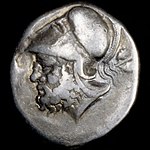
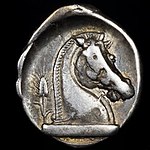
O: Bearded head of Mars with Corinthian helmet left. R: Horse head right, grain ear behind. The first Roman silver coin, 281 BCE. Crawford 13/1 Coinage followed Greek colonization and influence first around the Mediterranean and soon after to North Africa (including Egypt), Syria, Persia, and the Balkans.[55] Coins came late to the Roman Republic compared with the rest of the Mediterranean, especially Greece and Asia Minor where coins were invented in the 7th century BCE. The currency of central Italy was influenced by its natural resources, with bronze being abundant (the Etruscans were famous metal workers in bronze and iron) and silver ore being scarce. The coinage of the Roman Republic started with a few silver coins apparently devised for trade with Celtic in northern Italy and the Greek colonies in Southern Italy, and heavy cast bronze pieces for use in Central Italy. The first Roman coins, which were crude, heavy cast bronzes, were issued c. 289 BCE.[56] Amisano, in a general publication, including the Etruscan coinage, attributing it the beginning to about 550 BCE in Populonia, a chronology that would leave out the contribution of the Greeks of Magna Graecia and attribute to the Etruscans the burden of introducing the coin in Italy. In this work, constant reference is made to classical sources, and credit is given to the origin of the Etruscan Lydia, a source supported by Herodotus, and also to the invention of coin in Lydia.[44]
Middle Ages[edit]
The first European coin to use Arabic numerals to date the year in which the coin was minted was the St. Gall silver Plappart of 1424.[57]
Value[edit]

An unusual copper coin of King
George IV of Georgia with
Georgian inscriptions, 1210Currency[edit]
Most coins presently are made of a base metal, and their value comes from their status as fiat money. This means that the value of the coin is decreed by government fiat (law), and thus is determined by the free market only in as much as national currencies are used in domestic trade and also traded internationally on foreign exchange markets. Thus, these coins are monetary tokens, just as paper currency is: they are usually not backed by metal, but rather by some form of government guarantee. Some have suggested that such coins not be considered to be "true coins" (see below). Thus, there is very little economic difference between notes and coins of equivalent face value.
Coins may be in circulation with fiat values lower than the value of their component metals, but they are never initially issued with such value, and the shortfall only arises over time due to inflation, as market values for the metal overtake the fiat declared face value of the coin. Examples are the pre-1965 US dime, quarter, half dollar, and dollar (nominally containing slightly less than a tenth, quarter, half, and full ounce of silver, respectively), US nickel, and pre-1982 US penny. As a result of the increase in the value of copper, the United States greatly reduced the amount of copper in each penny. Since mid-1982, United States pennies are made of 97.5% zinc, with the remaining 2.5% being a coating of copper. Extreme differences between fiat values and metal values of coins cause coins to be hoarded or removed from circulation by illicit smelters in order to realize the value of their metal content. This is an example of Gresham's law. The United States Mint, in an attempt to avoid this, implemented new interim rules on December 14, 2006, subject to public comment for 30 days, which criminalized the melting and export of pennies and nickels.[58] Violators can be fined up to $10,000 and/or imprisoned for up to five years.
Collector's items[edit]
A coin's value as a collector's item or as an investment generally depends on its condition, specific historical significance, rarity, quality, beauty of the design and general popularity with collectors. If a coin is greatly lacking in all of these, it is unlikely to be worth much. The value of bullion coins is also influenced to some extent by those factors, but is largely based on the value of their gold, silver, or platinum content. Sometimes non-monetized bullion coins such as the Canadian Maple Leaf and the American Gold Eagle are minted with nominal face values less than the value of the metal in them, but as such coins are never intended for circulation, these face values have no relevance.
Collector catalogs often include information about coins to assists collectors with identifying and grading. Additional resources can be found online for collectors These are collector clubs, collection management tools, marketplaces,[59] trading platforms, and forums,
Media of expression[edit]
Coins can be used as creative media of expression – from fine art sculpture to the penny machines that can be found in most amusement parks. In the Code of Federal Regulations (CFR) in the United States there are some regulations specific to nickels and pennies that are informative on this topic. 31 CFR § 82.1 forbids unauthorized persons from exporting, melting, or treating any 5 or 1 cent coins.[60]
This has been a particular problem with nickels and dimes (and with some comparable coins in other currencies) because of their relatively low face value and unstable commodity prices. For a while,[when?] the copper in US pennies was worth more than one cent, so people would hoard pennies and then melt them down for their metal value. It cost more than face value to manufacture pennies or nickels, so any widespread loss of the coins in circulation could be expensive for the US Treasury. This was more of a problem when coins were still made of precious metals like silver and gold, so strict laws against alteration make more sense historically.[citation needed]
31 CFR § 82.2(b) goes on to state that: "The prohibition contained in § 82.1 against the treatment of 5-cent coins and one-cent coins shall not apply to the treatment of these coins for educational, amusement, novelty, jewelry, and similar purposes as long as the volumes treated and the nature of the treatment makes it clear that such treatment is not intended as a means by which to profit solely from the value of the metal content of the coins."[61]
Debasement and clipping[edit]
Throughout history, monarchs and governments have often created more coinage than their supply of precious metals would allow if the coins were pure metal. By replacing some fraction of a coin's precious metal content with a base metal (often copper or nickel), the intrinsic value of each individual coin was reduced (thereby "debasing" the money), allowing the coining authority to produce more coins than would otherwise be possible. Debasement occasionally occurs in order to make the coin physically harder and therefore less likely to be worn down as quickly, but the more usual reason is to profit from the difference between face value and metal value. Debasement of money almost always leads to price inflation. Sometimes price controls are at the same time also instituted by the governing authority, but historically these have generally proved unworkable.
The United States is unusual in that it has only slightly modified its coinage system (except for the images and symbols on the coins, which have changed a number of times) to accommodate two centuries of inflation. The one-cent coin has changed little since 1856 (though its composition was changed in 1982 to remove virtually all copper from the coin) and still remains in circulation, despite a greatly reduced purchasing power. On the other end of the spectrum, the largest coin in common circulation is valued at 25 cents, a very low value for the largest denomination coin compared to many other countries. Increases in the prices of copper, nickel, and zinc meant that both the US one- and five-cent coins became worth more for their raw metal content than their face (fiat) value. In particular, copper one-cent pieces (those dated prior to 1982 and some 1982-dated coins) contained about two cents' worth of copper.
Some denominations of circulating coins that were formerly minted in the United States are no longer made. These include coins with a face value of a half cent, two cents, three cents, and twenty cents. (The half dollar and dollar coins are still produced, but mostly for vending machines and collectors.) In the past, the US also coined the following denominations for circulation in gold: One dollar, $2.50, three dollars, five dollars, ten dollars, and twenty dollars. In addition, cents were originally slightly larger than the modern quarter and weighed nearly half an ounce, while five-cent coins (known then as "half dimes") were smaller than a dime and made of a silver alloy. Dollar coins were also much larger, and weighed approximately an ounce. One-dollar gold coins are no longer produced and rarely used. The US also issues bullion and commemorative coins with the following denominations: 50¢, $1, $5, $10, $25, $50, and $100.
Circulating coins commonly suffered from "shaving" or "clipping": the public would cut off small amounts of precious metal from their edges to sell it and then pass on the mutilated coins at full value.[62] Unmilled British sterling silver coins were sometimes reduced to almost half their minted weight. This form of debasement in Tudor England was commented on by Sir Thomas Gresham, whose name was later attached to Gresham's law. The monarch would have to periodically recall circulating coins, paying only the bullion value of the silver, and reminting them. This, also known as recoinage, is a long and difficult process that was done only occasionally.[63] Many coins have milled or reeded edges, originally designed to make it easier to detect clipping.
Other uses[edit]
Some convicted criminals from the British Isles who were sentenced to transportation to Australia in the 18th and 19th centuries used coins to leave messages of remembrance to loved ones left behind in Britain. The coins were defaced, smoothed and inscribed, either by stippling or engraving, with sometimes touching words of loss. These coins were called "convict love tokens" or "leaden hearts".[64] A number of these tokens are in the collection of the National Museum of Australia.
Modern features[edit]
The side of a coin carrying an image of a monarch, other authority (see List of people on coins), or a national emblem is called the obverse (colloquially, heads); the other side, carrying various types of information, is called the reverse (colloquially, tails). The year of minting is usually shown on the obverse, although some Chinese coins, most Canadian coins, the pre-2008 British 20p coin, the post-1999 American quarter, and all Japanese coins are exceptions.
The relation of the images on the obverse and reverse of a coin is the coin's orientation. If the image on the obverse of the coin is right side up and turning the coin left or right on its vertical axis reveals that the reverse of the coin is also right side up, then the coin is said to have medallic orientation—typical of the Euro and pound sterling; if, however, turning the coin left or right shows that the reverse image is upside down, then the coin is said to have coin orientation, characteristic of the United States dollar coin.
Bimetallic coins are sometimes used for higher values and for commemorative purposes. In the 1990s, France used a tri-metallic coin. Common circulating bimetallic examples include the €1, €2, British £1, £2 and Canadian $2 and several peso coins in Mexico.
The exergue is the space on a coin beneath the main design, often used to show the coin's date, although it is sometimes left blank or contains a mint mark, privy mark, or some other decorative or informative design feature. Many coins do not have an exergue at all, especially those with few or no legends, such as the Victorian bun penny.
Not all coins are round; they come in a variety of shapes. The Australian 50-cent coin, for example, has twelve flat sides. Some coins have wavy edges, e.g. the $2 and 20-cent coins of Hong Kong and the 10-cent coins of Bahamas. Some are square-shaped, such as the 15-cent coin of the Bahamas and the 50-cent coin from Aruba. During the 1970s, Swazi coins were minted in several shapes, including squares, polygons, and wavy edged circles with 8 and 12 waves.
Some other coins, like the British 20 and 50 pence coins and the Canadian Loonie, have an odd number of sides, with the edges rounded off. This way the coin has a constant diameter, recognizable by vending machines whichever direction it is inserted.
A triangular coin with a face value of £5 (produced to commemorate the 2007/2008 Tutankhamun exhibition at The O2 Arena) was commissioned by the Isle of Man: it became legal tender on 6 December 2007.[65] Other triangular coins issued earlier include: Cabinda coin, Bermuda coin, 2 Dollar Cook Islands 1992 triangular coin, Uganda Millennium Coin and Polish Sterling-Silver 10-Zloty Coin.
Some medieval coins, called bracteates, were so thin they were struck on only one side.
Many coins over the years have been manufactured with integrated holes such as Chinese "cash" coins, Japanese coins, Colonial French coins, etc. This may have been done to permit their being strung on cords, to facilitate storage and being carried. Nowadays, holes help to differentiate coins of similar size and metal, such as the Japanese 50 yen and 100 yen coin.
The Royal Canadian Mint is now able to produce holographic-effect gold and silver coinage. However, this procedure is not limited to only bullion or commemorative coinage. The 500 yen coin from Japan was subject to a massive amount of counterfeiting. The Japanese government in response produced a circulatory coin with a holographic image.
The Royal Canadian Mint has also released several coins that are colored, the first of which was in commemoration of Remembrance Day. The subject was a colored poppy on the reverse of a 25-cent piece minted through a patented process.[66]
An example of non-metallic composite coins (sometimes incorrectly called plastic coins) was introduced into circulation in Transnistria on 22 August 2014. Most of these coins are also non-circular, with different shapes corresponding to different coin values.[67]
For a list of many pure metallic elements and their alloys which have been used in actual circulation coins and for trial experiments, see coinage metals.[68]
Physics and chemistry[edit]
Flipping[edit]
To flip a coin to see whether it lands heads or tails is to use it as a two-sided dice in what is known in mathematics as a Bernoulli trial: if the probability of heads (in the parlance of Bernoulli trials, a "success") is exactly 0.5, the coin is fair.
Spinning[edit]
Coins can also be spun on a flat surface such as a table. This results in the following phenomenon: as the coin falls over and rolls on its edge, it spins faster and faster (formally, the precession rate of the symmetry axis of the coin, i.e., the axis passing from one face of the coin to the other) before coming to an abrupt stop. This is mathematically modeled as a finite-time singularity – the precession rate is accelerating to infinity, before it suddenly stops, and has been studied using high speed photography and devices such as Euler's Disk. The slowing down is predominantly caused by rolling friction (air resistance is minor), and the singularity (divergence of the precession rate) can be modeled as a power law with exponent approximately −1/3.[69]
Odor[edit]
Iron and copper coins have a characteristic metallic smell that is produced upon contact with oils in the skin. Perspiration is chemically reduced upon contact with these metals, which causes the skin oils to decompose, forming with iron the volatile molecule 1-octen-3-one.[70]
Regional examples[edit]
Philippines[edit]
 This article's tone or style may not reflect the encyclopedic tone used on Wikipedia. (February 2019) (Learn how and when to remove this template message)
Piloncitos are small engraved gold coins found in the Philippines. Some piloncitos are of the size of a corn kernel and weigh from 0.09 to 2.65 grams of fine gold. Piloncitos have been excavated from Mandaluyong, Bataan, the banks of the Pasig River, Batangas, Marinduque, Samar, Leyte and some areas in Mindanao. They have been found in large numbers in Indonesian archaeological sites leading to questions of origin such as whether they were made in the Philippines or imported. However. many Spanish accounts state that the gold coins are mined and labored in the Philippines, such as the following in 1586:
See also[edit]


._Heavy_series._Sardes_mint.jpg)


._Mid_5th_century_BC.jpg)


.png)


.jpg)


- Auction catalog
- Exchange rate
- Manillas – a form of primitive or archaic money.
- World Money Fair
- Leper colony money
- List of most expensive coins
- Philately


Comments
Post a Comment